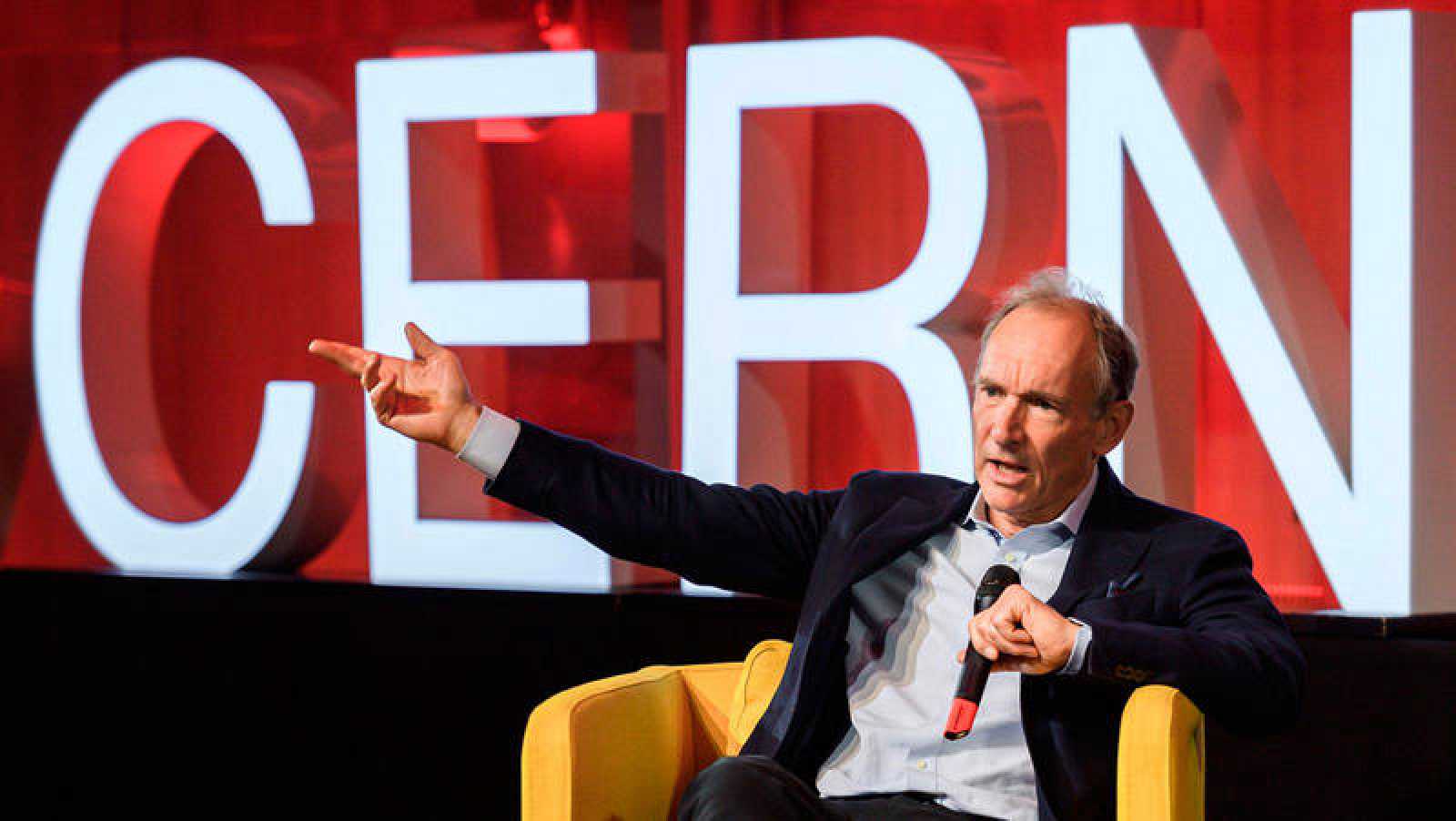
 Image credit: source unknown / rights reserved by the photographer
Tim Berners-Lee, one of the founding fathers of the modern web
Sir Tim Berners-Lee, one of the founding fathers of the World Wide Web, played a crucial role in creating one of the most transformative tools of our time. Born on 8 June 1955 in London, United Kingdom, Berners-Lee studied at Oxford University, where he graduated with a degree in physics. It was in the late 1980s, while working at CERN, the European Centre for Nuclear Research in Geneva, that he conceptualised and developed the foundations of the World Wide Web.
The birth of the World Wide Web
The World Wide Web, often confused with the Internet, is actually a hypertext system accessible via the Internet. Tim Berners-Lee first proposed the idea of a hypertext information system in 1989, in a document entitled ‘Information Management: A Proposal’. This concept aimed to facilitate communication and information sharing between scientists at CERN, where, as CERN explains on its website, Tim Berners-Lee developed the foundations of the World Wide Web in 1989. At that time, the Internet already existed, but there was no simple, universal way to share and access information. Berners-Lee therefore developed three fundamental technologies to make his idea viable. :
-
HTML (HyperText Markup Language) : A simple markup language for creating web pages. HTML allows you to structure the content of a web page, using tags to define headings, paragraphs, links, images, etc.
-
HTTP (Hypertext Transfer Protocol) : A communication protocol that enables HTML documents (and other resources) to be transferred between a web server and a browser. HTTP defines how browsers request pages from servers and how servers respond to these requests.
-
URL (Uniform Resource Locator) : A standard addressing system for uniquely identifying each resource on the web. URLs enable users to easily find and share information on the web.
The impact and legacy of Tim Berners-Lee
Tim Berners-Lee's work has revolutionised the way we communicate, work, learn and entertain ourselves. In 1991, the first website went live, and the World Wide Web quickly began to spread beyond the confines of CERN. The simplicity and accessibility of these technologies have enabled millions of people, without advanced technical skills, to contribute to and use the web.
Subsequent contributions
After his initial work on the World Wide Web, Tim Berners-Lee continued to play an important role in its development and evolution. In 1994, he founded the World Wide Web Consortium (W3C) at MIT, an organisation that sets standards for the web, ensuring its interoperability and evolution.
He also defended principles such as openness and neutrality of the web, emphasising the importance of a free and accessible web for all. In this context, he was a staunch supporter of net neutrality and advocated for the protection of user privacy, particularly in the face of the risks of surveillance and data concentration by large technology companies.
Current challenges
Today, the web faces new challenges: misinformation, surveillance, the concentration of power among a few large companies, and issues of privacy and security. Tim Berners-Lee continues to be an influential voice in these debates, calling for an overhaul of the foundations of the web to better protect users and promote a more ethical and inclusive use of technology.
Conclusion
Tim Berners-Lee not only created a revolutionary tool, but also demonstrated the importance of openness, collaboration and transparency in technological development. His work has changed the world, and he continues to inspire a new generation of innovators to consider the ethical and social implications of their creations. As an innovator, educator and advocate for openness, Tim Berners-Lee remains a central figure in the history of modern computing and communication.